
Air Duct Cleaning: Repair or Replace? How Arvada Homeowners Decide
Most duct replacement quotes are written before anyone has looked at the whole system. That’s the problem. A technician walks in, sees a crushed run of flex in the attic, and recommends a full replacement when the honest answer is a repair and a reseal. Meanwhile, a system with sheet metal trunk lines and one loose joint gets sold a new build-out it never needed. The decision isn’t a price calculation. It’s a condition and geometry assessment, and it looks different in every Arvada house. If you’d rather not climb into a crawlspace with a flashlight to sort it out yourself, call (866) 623-9426.
Key Takeaways
- Duct material and layout matter more than total square footage in the repair-or-replace call.
- Measured leakage rate, not visible dust, is the single most useful data point.
- Isolated damage on sheet metal favors repair; pervasive problems on flex favor replacement.
- A proper verification test after the work is done separates a real fix from a hopeful one.
What duct materials are in an Arvada home, and why does it matter?
Arvada’s housing stock spans a wide range of vintages, and the duct system in each is a fingerprint of when it was built. The material matters because each one fails differently, and each one prices out very differently on a repair-versus-replace sheet.
- Sheet metal – Usually the original rigid duct in mid-century homes and in older Arvada neighborhoods near the historic core. Lifespan runs decades if joints are sealed. Failure modes are isolated: a separated joint, cracked mastic, a dented section, a boot pulling away from a floor register. These almost always favor repair.
- Flexible duct – Common in additions, retrofits, and homes built from the 1980s forward. Flex has a shorter service life and degrades from sag, kinks, and crush. A single collapsed run can be replaced cheaply, but a whole system with multiple 90-degree turns in flex runs the risk of costing more to repair than to replace.
- Fiberboard duct – Found in some 1970s and 1980s builds and in manufactured housing. It’s the most vulnerable to moisture. Fiberboard that has absorbed water and developed mold across a wide area generally argues for replacement.
If you’re not sure what you have, the first ten minutes of a proper inspection will tell a technician. Ask them to identify the material, note the vintage, and photograph what they find. If they won’t, that’s a signal on its own.
What’s the most useful number in the repair-versus-replace decision?
Duct leakage rate, expressed as a percentage of total system airflow. It’s more useful than the amount of dust you can see, more useful than the age of the system, and more useful than a visual walk-through. A duct blaster test pressurizes the system and measures how much air escapes into unconditioned space. A blower door test isolates the house and confirms how the envelope behaves. Together they give you a real number to work from.
Here’s how to read it:
- Under 10% leakage – Tight system. Cleaning and minor joint touch-up is usually the right call.
- 10-20% leakage – Meaningful loss, but almost always recoverable with sealing. Repair is the sensible path.
- 20-30% leakage – Needs a material review. Sheet metal in this range frequently seals well. Flex with multiple runs may be cheaper to rebuild.
- Above 30% leakage – If the system is flex or fiberboard and shows damage across multiple runs, the honest conversation often turns to replacement.
A leaky system wastes conditioning, pulls attic or crawlspace air into the house, and makes the dust problem worse rather than better. The number tells you whether to throw effort at sealing or at rebuilding.
Which types of damage favor repair, and which favor replacement?
We’ve seen the same conversation play out many times in Arvada: a homeowner is told they need a full replacement when a repair would solve the problem, or the reverse. Here’s the framework we use.
Conditions that favor repair
- Disconnected joints between trunk and branch runs
- Isolated collapse on a single flex run
- Minor mastic failure at seams
- Loose register boots pulling away from drywall
- One or two runs with a kink or a sag that can be re-strapped
Conditions that favor replacement
- Pervasive mold through flex or fiberboard, with moisture present
- Rodent or animal intrusion across the system, with nesting and contamination in multiple runs
- Multiple 90-degree turns built into flex duct, which magnifies airflow loss and is expensive to rework piece by piece
- Fiberboard duct that has absorbed water and begun to break down internally
- A layout so tangled that re-routing makes more sense than resealing
The pattern holds in most Arvada homes. Isolated damage on a rigid system is almost always a repair. Pervasive damage on flex or fiberboard is often a replacement. The grey zone, where a system has both good and bad sections, is where measured leakage and a proper inspection earn their keep. If we find a gap, a tear, or a loose connection during cleaning, we can seal it on the spot so the problem doesn’t wait for a separate visit. When replacement is the honest answer, we say so.
How does Arvada’s climate stress ductwork over time?
Arvada sits at the edge of the Front Range, and the temperature swing between winter and summer, and even between day and night, is wide. That swing hits ductwork in unconditioned spaces the hardest. Attic runs, crawlspace trunks, and garage-adjacent branches see every one of those swings, and the materials move with them.
Flex duct that’s suspended on strapping will sag a little more each year. Mastic at metal seams will crack and pull. Fiberboard that absorbs moisture during one season can fail during the next. Every wide swing is a small cycle of expansion and contraction on joints that were meant to stay sealed. This is why a duct system that tested decently a few years ago can test notably worse now, and why we recommend checking leak numbers rather than trusting the age of a system.
Because Arvada homes frequently have ductwork that runs through unconditioned space, the climate accelerates the timeline for when a repair decision moves toward replacement. A system that would last a decade longer in a milder climate can reach the replacement threshold sooner here. That’s not a sales line. It’s a real observation that should inform the conversation.
What does a proper verification look like after the work is done?
This is the step most installers skip, and it’s the one that tells you whether the investment worked. If the ducts were sealed, they should be pressure-tested afterward. If they were replaced, the system should be balanced so the airflow actually reaches all the rooms it’s meant to serve. Without that step, you’re guessing.
- Post-sealing leak test – A repeat duct blaster test tells you the new leakage rate. If it hasn’t dropped meaningfully, the sealing didn’t take.
- Airflow balancing – Registers are measured so the rooms that were cold stay room-temperature and the rooms that were hot get the share they need.
- Static pressure check – Confirms the blower isn’t fighting a system that’s been built too tight or too restrictive.
- Photographic documentation – Before-and-after photos of the actual ducts, not a stock photo from the internet.
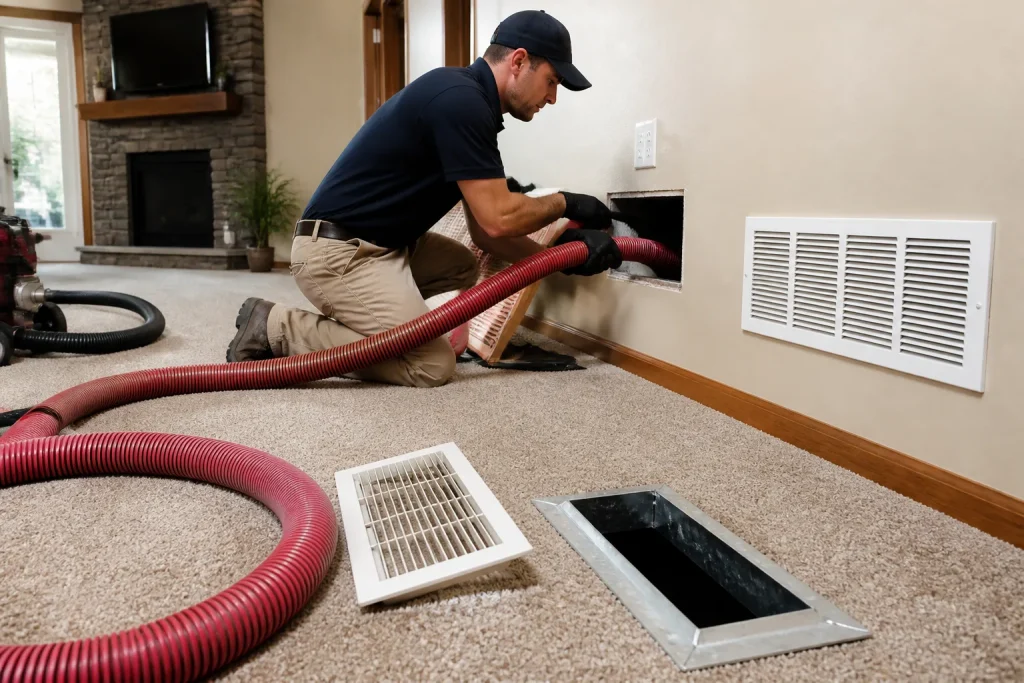
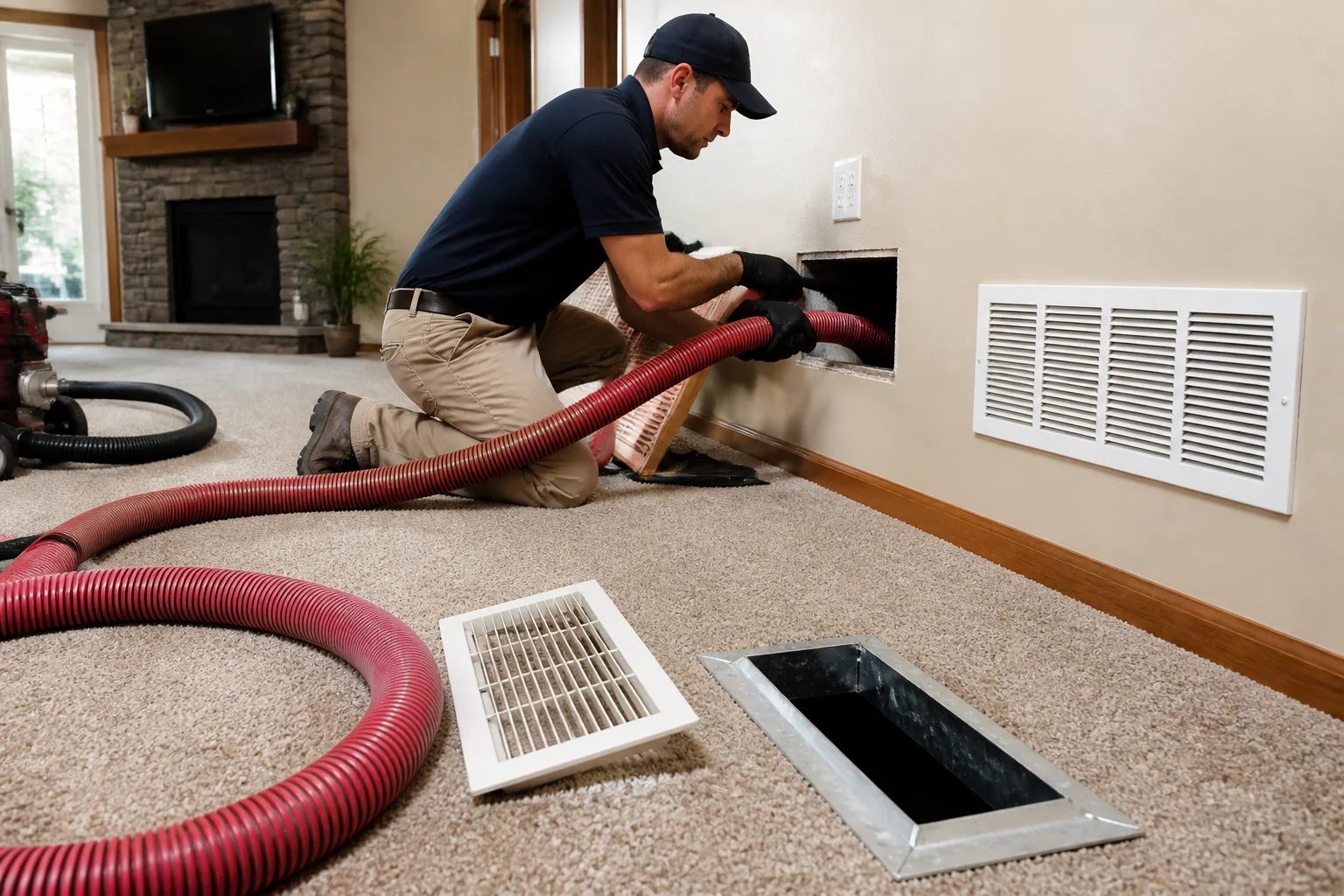
Our air duct cleaning process runs on the same principle. We use mechanical agitation with a Rotobrush and pair it with HEPA-filtered source-removal vacuums from Nikro and Abatement Technologies, so debris comes out of your home rather than back into it. That process, plus a measured leak test, gives you a real data point. Anything less is a promise.
When to call a pro
If you’ve noticed musty odors when the system kicks on, more dust than usual on the furniture a day after cleaning, allergy symptoms that get worse indoors, or rooms that never get the airflow they should, the system is telling you something. A blower door or duct blaster test isn’t a DIY project, and neither is chasing flex duct through an attic on a windy day. That’s where we come in. We handle dryer vent cleaning and HVAC cleaning as part of the same visit, so you’re not coordinating three contractors to solve one problem. If you want whole-home IAQ recommendations beyond the ducts themselves, we work with Honeywell and Aprilaire systems as part of a broader evaluation.
Related services in Arvada: duct repair and sealing, air quality sanitizing with Guardsman protective treatment, and dryer vent cleaning. All handled by the same team.
The Bottom Line
Repair or replace on Arvada ductwork comes down to material, geometry, and measured leakage. Isolated damage on sheet metal is almost always worth repairing. Pervasive damage on flex or fiberboard, especially with multiple 90-degree turns or moisture present, usually argues for replacement. The number you want is the leakage percentage, and the verification you want afterward is a repeat test. If you’re in Arvada and need help deciding, Arvada Air Duct Cleaning Pros offers free estimates. Call (866) 623-9426. Our technicians have up to 10 years of experience with the full duct system, and we clean, repair, seal, and sanitize as one job rather than three.
Frequently Asked Questions
Whole-system air duct cleaning in Arvada typically runs in a range that depends on the number of runs, the material, and how much repair is needed alongside cleaning. There’s no honest per-vent price, and anyone quoting one before seeing the system is guessing. We set one flat price per system by written estimate, agreed before work starts. Call (866) 623-9426 for an exact quote. Estimates are free.
Cheap quotes usually skip the source-removal step. Blow-and-go cleaners dislodge dust with a shop vac and let it recirculate, then send you a bill. The work looks the same on the invoice and is very different in your house. Ask what equipment they use. If the answer isn’t a professional agitation tool plus a HEPA-rated vacuum, the price is telling you something. Call (866) 623-9426 for a straight answer on what a real job involves.
You ask for before-and-after photos of your own ducts, and you ask for a post-work leak test. Neither one is unreasonable. Any contractor who won’t produce both is telling you they don’t have the equipment to prove it. We document every job for that reason. Call (866) 623-9426. We answer 24/7, with fast dispatch from 7am to 7pm, Sunday through Friday.
It depends on the system more than the calendar. A tight, well-sealed system in an Arvada home with pets and regular filter changes can go several years. Flex duct running through an unconditioned attic, a home with recent renovation dust, or a system that has pulled contamination from a crawlspace usually needs attention sooner. A measured leak test and a visual inspection will tell you what your system actually needs. Call (866) 623-9426 if you’d rather not guess.
Written by the team at Arvada Air Duct Cleaning Pros.
Need Air Duct Cleaning Help?
Call Arvada Air Duct Cleaning Pros - the local pro we connect you with is licensed and insured, here with fast help in Arvada.
(866) 623-9426